Events near Arsenal
- 🚶Cultural and sporting walk - Central route
- 🏛️Win Tickets for Exhibition "Hugo and Architecture. From Stone to Pen"
- 🎤Playlunch • Wild Pink
- 🏛️Exhibition: Dead Train by Le Turk
Monuments & viewpoints
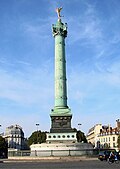 July Column
 Temple du Marais
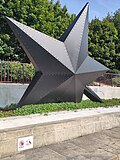 Aux oubliées et oubliés
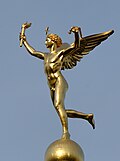 Le Génie de la Liberté
 Beaumarchais
 Chronos 10
- L'Homme aux semelles devant
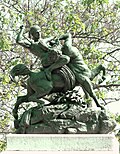 Theseus Fighting the Centaur Bienor
The July Column is a monumental column in Paris commemorating the Revolution of 1830. It stands in the center of the Place de la Bastille and celebrates the Trois Glorieuses — the 'three glorious' days of 27–29 July 1830 that saw the fall of Charles X, King of France, and the commencement of the Jul… Wikipedia · CC BY-SA
The Temple du Marais, sometimes known as the Temple Sainte-Marie, or historically, as the Church of Sainte Marie de la Visitation, is a Protestant church located in the 4th arrondissement of Paris, in the district of Le Marais at 17 Rue Saint-Antoine. Wikipedia · CC BY-SA
Museums & galleries
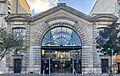 Pavillon de l'Arsenal
- 🖼️L'Atlas
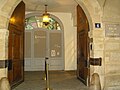 Maison de Victor Hugo
- 🖼️Marciano Contemporary
- 🏛️Win Tickets for Exhibition "Hugo and Architecture. From Stone to Pen"
- 🏛️Grand Palais Immersif
- 🖼️Le XVI
- 🖼️Artpark
The Pavillon de l'Arsenal (French pronunciation: [pavijɔ̃ də laʁsənal]) is the Paris Center for architecture and urbanism, a center for urban planning and museum located in the 4th arrondissement at 21, boulevard Morland, Paris, France. It is open daily except Mondays; admission is free. Wikipedia · CC BY-SA
The Maison de Victor Hugo (French pronunciation: [mɛzɔ̃ d(ə) viktɔʁ yɡo]; Victor Hugo's House) is a writer's house museum located in the 4th arrondissement of Paris, where Victor Hugo lived for 16 years between 1832 and 1848. Wikipedia · CC BY-SA
Restaurants in Arsenal
- 🍽️Blanc de Noirs
- 🍽️Orchidée & KHMER THAÏ
- 🍽️Ilô
- 🍽️Na Ruga
- 🍽️B.Better
- 🍽️Le Grand Bleu
- 🍽️Il Quadrifoglio
- 🍽️L'Enoteca
- 🍽️Le Chanard
- 🍽️Brutus
Bars in Arsenal
- 🍸Magnum La Cave - Vins Bios Et Naturels
- 🍸Hôtel So Paris
- 🍸Les Amoureuses
- 🍸Le Vanart'
- 🍸Les Associés
- 🍸La Marguerite
- 🍸Oh la la !
- 🍸Charlotte
- 🍸Folie Bastille
- 🍸Bar des Ferrailleurs
Cafés in Arsenal
- ☕Le Réveil Bastille
- ☕Bangkok Café
- ☕Le Rempart
- ☕Nāu Café
- ☕Juni Coffee
- ☕Creem
- ☕Bubblywaff
- ☕Café Abel
- ☕Cafe Français
- ☕Café Mulot
Pâtisseries in Arsenal
- 🧁Boulangerie Patrick et Christine
- 🧁Boulangerie Saint-Antoine
- 🧁Hoso Basque
- 🧁Benoit chocolats
- 🧁Land&Monkeys Turenne
- 🧁Les Petits Pains ronds
Bookshops
- 📚Librairie Henri IV
- 📚La Belle Lurette Jeunesse
- 📚La belle Lurette
- 📚Opéra BD
- 📚Sur le fil de Paris
- 📚Paris Design Week: Olfactory Installation in Victor Hugo's House Garden
Cinemas, theatres & live music
- 🎤Playlunch • Wild Pink
- 🎭Opéra Bastille
The Opéra Bastille (French: [ɔpeʁa bastij] , "Bastille Opera House") is a modern opera house in the 12th arrondissement of Paris, France. Wikipedia · CC BY-SA
Markets & delis
- 🥘La Manufacture Kaviari
- 🥘Sicile & co
- 🥘L’Ardèche à Paris
- 🥘Famille Mary
- 🥘Apertivus
- 🥘Chez Teil Produits d'Auvergne
Parks & gardens

Where the street names come from
- rue Agrippa d'Aubigné — Théodore Agrippa d'Aubigné (1552-1630), poet, soldier and historian.
- rue Bassompierre — François de Bassompierre (1579-1646), Marshal of France; near the former Arsenal.
- rue Beautreillis — Opened on the site of the Hôtel de Beautreillis, which owed its name to the trellises in the gardens of the Hôtel Saint-Paul.
- cour Bérard — Mr Bérard, owner.
- rue Biscornet — Biscornet, locksmith, maker of the ironwork on the doors of Notre-Dame.
- boulevard Bourdon — Bourdon, colonel of the 11th dragoon regiment, killed at the battle of Austerlitz on 2 December 1805.
- rue Castex — Pierre Castex (1760-1805), colonel of the 13th light infantry regiment, killed at the battle of Austerlitz; near the pont d'Austerlitz.
- rue Charles V — Charles V, King of France (1337-1380), near the Hôtel Saint-Paul, created by this sovereign.
- rue Crillon — Louis des Balbes de Berton (1541-1615), lord of Crillon, French soldier, comrade-in-arms of Henri IV; near the Arsenal.
- quai d'Anjou — The Duke of Anjou, brother of Louis XIII.
- cour Damoye — Mr Damoye, landowner.
- rue Daval — Antoine François Daval, alderman from 1777 to 1779.
- rue de Birague — René de Birague (1507-1583), cardinal and Chancellor of France; near the site of the fountain he had completed and to which he had given his name.
- rue de Bretonvilliers — It was opened by Claude Le Ragois de Bretonvilliers, owner of a vast piece of land; his mansion occupied the east side of the street.
- rue de Brissac — Charles de Cossé, duc de Brissac, peer and Marshal of France, died in 1621, handed over the keys of Paris to Henri IV on 22 March 1594; near the former Arsenal.
- rue de l'Arsenal — Laid out within the precinct of the former Arsenal.
- rue de l'Hôtel Saint-Paul — Near the former Hôtel Saint-Paul.
- cour de l'Île Louviers — Recalling a historic island in the Seine, known as the île Louviers, which was joined to the right bank.
- passage de l'Île Louviers — Recalling a historic island in the Seine, known as the île Louviers, which was joined to the right bank.
- boulevard de la Bastille — Near place de la Bastille.
- place de la Bastille — Square created on the site of the Bastille fortress, built in 1369 and captured on 14 July 1789.
- rue de la Bastille — Near place de la Bastille.
- rue de la Cerisaie — Avenue of cherry trees in the gardens of the Hôtel Saint-Paul.
- rue de Lappe — Opened on land belonging to Girard de Lappe, gardener (17th century).
- rue de Lesdiguières — Former mansion of the Constable of Lesdiguières (1543-1626).
- rue de Schomberg — Gaspard de Schomberg or Schonberg (1540-1599), soldier of German origin, one of Henri IV's companions in arms; near the Arsenal.
- rue de Sully — Maximilien de Béthune, Baron of Rosny and Duke of Sully (1560-1641), minister of Henri IV, lived at the Arsenal as Grand Master of the Artillery.
- port des Célestins — Célestins convent founded in 1352.
- quai des Célestins — Célestins convent founded in 1352.
- rue des Lions Saint-Paul — Opened on the site of part of the gardens of the Hôtel Saint-Paul, where the king's lions were kept.
- esplanade des Villes Compagnons de la Libération — In tribute to the five French communes (Nantes, Grenoble, Paris, Vassieux-en-Vercors and the Ile de Sein) that received the Cross of the Liberation, awarded to individuals or to military and civilian communities that distinguished themselves in the work of liberating France during the Second World War.
- cour du Cantal — In former times the residents of this courtyard came largely from the Cantal department.
- passage du Cheval Blanc — Former shop sign.
- cour du Nom de Jésus — Former shop sign.
- rue du Pasteur Wagner — Charles Wagner (1852-1918), French pastor.
- place du Père Teilhard de Chardin — Pierre Teilhard de Chardin (Orcines, 1881-New York, 1955), French theologian, philosopher and palaeontologist.
- rue du Petit Musc — Corruption of Pute y Musse, a name given because of the population living there.
- impasse Guéménée — This lane served as a service access to the Hôtel Guéménée.
- boulevard Henri IV — Henri IV, King of France (1553-1610); near the Arsenal, residence of Sully.
- port Henri IV — Near the quai Henri IV. Henri IV, King of France (1553-1610)
- quai Henri IV — Henri IV, King of France (1553-1610)
- rue Jacques Coeur — Jacques Coeur (1395-1456), treasurer to Charles VII; near the former Hôtel Saint-Paul.
- cour Jacques Viguès — Name of an owner.
- impasse Jean Beausire — Near the rue Jean Beausire; a family of notable bourgeois, one of whose descendants, who died in 1743, was master of works and comptroller general of the City's buildings. No relation to the Beausire family of architects, active in Paris in the 17th and 18th centuries.
- passage Jean Beausire — Near the rue Jean Beausire; a family of notable bourgeois, one of whose descendants, who died in 1743, was master of works and comptroller general of the City's buildings. No relation to the Beausire family of architects, active in Paris in the 17th and 18th centuries.
- rue Jean Beausire — A family of notable bourgeois, one of whose descendants, who died in 1743, was master of works and comptroller general of the City's buildings. No relation to the Beausire family of architects, active in Paris in the 17th and 18th centuries.
- passerelle Jim Morrison — Jim Morrison (Melbourne (Florida), 1943 – Paris, 1971), singer and poet. Leader of the Doors.
- rue Jules Cousin — Jules Cousin (1830-1899), founder of the musée Carnavalet; in the vicinity of the bibliothèque de l'Arsenal, of which he was librarian.
- rue Lacuée — General Lacuée (1774-1805), colonel of the 59th regiment of the line; killed in the fighting at Gunzbourg (Austerlitz campaign); in the vicinity of the pont d'Austerlitz.
- boulevard Morland — Morland, colonel of the chasseurs of the Guard, killed at the battle of Austerlitz; near the pont d'Austerlitz.
- pont Morland — Near the boulevard Morland.
- rue Mornay — Philippe de Mornay, lord of Duplessis-Marly, known as Duplessis-Mornay (1549-1623), French Protestant leader, supporter of Henri IV; near the Arsenal.
- cité Parchappe — Mr Parchappe, owner.
- place Philippe de Broca — Philippe de Broca, born Philippe Claude Alex de Broca (Paris, 1933 - Neuilly-sur-Seine, 2004). French screenwriter, producer and director.
- esplanade Roger Joseph Boscovich — Roger Joseph Boscovich (Raguse (Dubrovnik), 1711-Milan, 1787), Croatian philosopher, a symbol of the Age of Enlightenment.
- rue Saint-Antoine — Led to the abbey of Saint-Antoine, converted into a hospital in 1790.
- cour Saint-Louis — Former shop sign.
- rue Saint-Paul — The former church of Saint-Paul stood on this street.
Source: City of Paris, official street names (ODbL).
Real data: events from the City of Paris Open Data, places from OpenStreetMap. Availability changes continuously — open the tool to see what's open right now, around you.